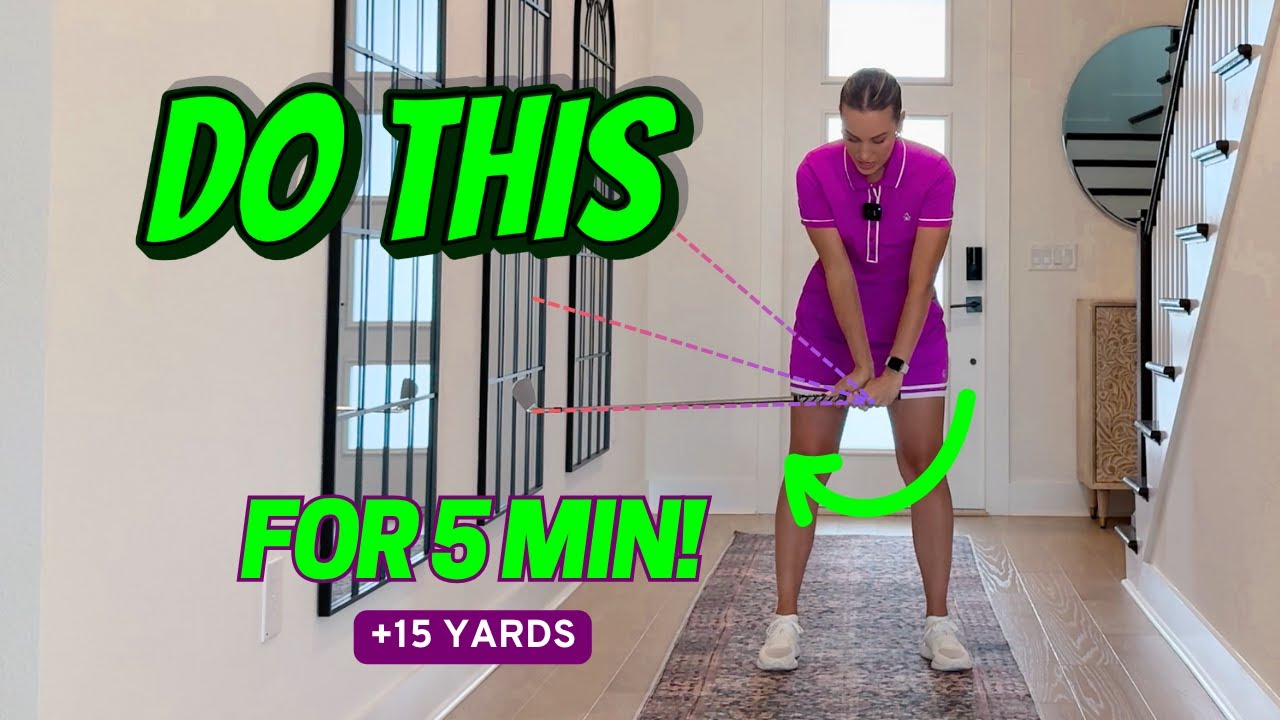
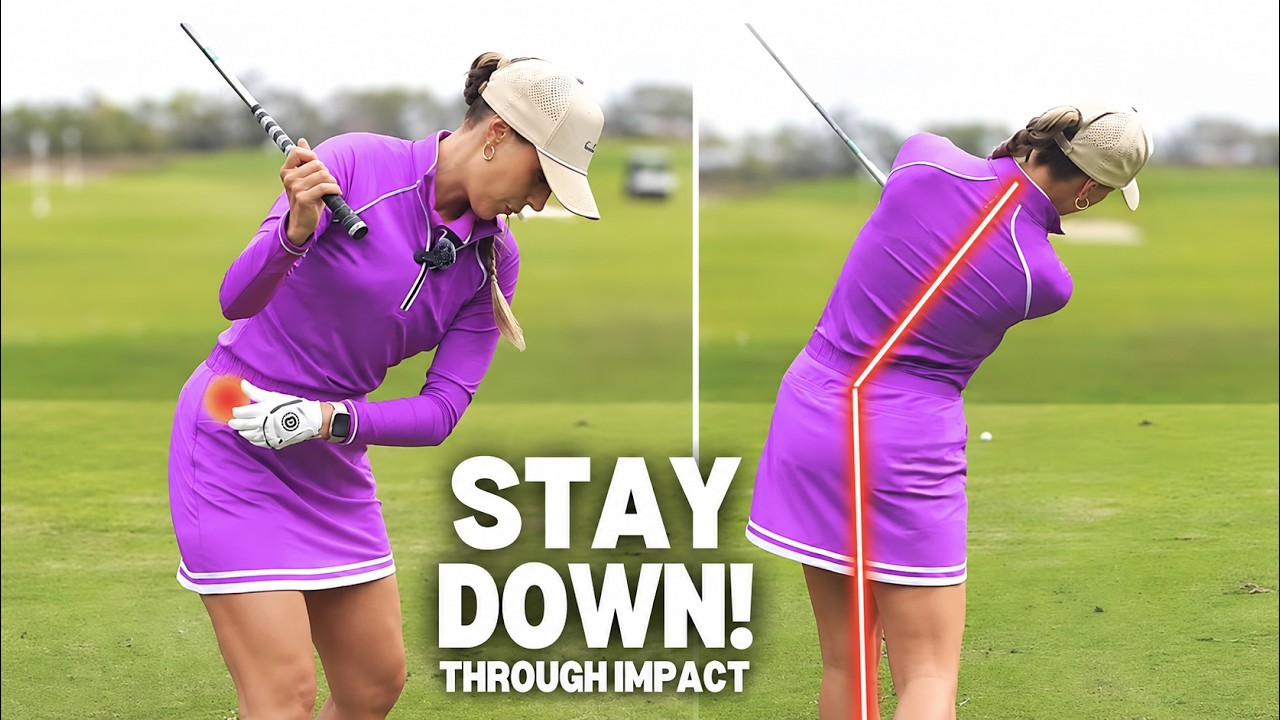
Why the ratio matters
Your arms are attached to your body. When your shoulders, hips and knees turn in the right ratio, you have room to drop the club and turn through.
Many golfers rush toward the target before the backswing is finished. The result is an arms-only swing that's hard to time. If your body limits your turn, keep the ratio: with less shoulder turn, turn your hips less too.
“your arms don't drive it they're attached to your body”
Coach Carolin, in the lesson at 0:28
The rotation check
- Set up and turn your shoulders about 90 degrees, or as far as your body comfortably allows.
- Check your hips: about half your shoulder turn, around 45 degrees.
- Check your knees: about half of your hip turn.
- Film it from down the line or face-on to see the ratio.
- Before you start down, think 'finish your backswing' or feel a short pause at the top.
How you know it's working
Your shoulders clearly turn more than your hips.
You feel room to drop the club at the top.
The transition feels calmer, without rushing.
Free: Full Swing Cheat Sheet
Carolin's key positions on one page, for the range.
Key takeaways
Body drivesYour arms follow your turn.
90, 45, halfShoulders, hips, knees.
Keep the ratioEven if your turn is shorter.
Finish itThen start down.
Questions golfers ask
How far should my shoulders turn in the backswing?
About 90 degrees is the textbook number. It varies with flexibility, and restrictions are fine as long as you keep the ratio.
How far should my hips turn?
About half your shoulder turn, around 45 degrees.
Why do I rush my downswing?
Often the backswing isn't finished. Think 'finish your backswing' or pause briefly at the top.
Not sure your turn is the problem?Tell Carolin what your ball does and get your personal fix. Free.
Find my missRead the full video transcript
Auto-captions, lightly edited for names and golf terms.
hi everybody and welcome I'm Coach Carolin here Leadbetter certified instructor and former professional Tour player and today I want to talk to you guys about the correct chest rotation pelvis rotation body rotation really on the way back in the back swing and why it matters to make sure you get your Club consistently and solidly back towards the ball over and over and over again so let's jump into it so body rotation is a really really important piece of the golf swing because it drives your entire golf swing really your arms don't drive it they're attached to your body your core your chest and your rotation setup drives the golf swing and drives the forces so that is why it's fundamentally key to understand what they do and what the position should look like uh and what they do and how that translates into your impact and into your ball flight so um today we're going to focus on the back swing on the rotation back because that's actually going to have a huge impact on our rotation forward and to our contact so I want to start with some numbers and I'm sure you guys have all heard about the 90° shoulder turn on the way back and the top position and that's correct that's the textbook number but really there's a range of course if you look at the women's pro tour it tends to be a little bit higher like 100 degrees um versus 90 because women tend to be a little bit more flexible but then on the PGA tour men are more muscular on the top it makes them a little bit tighter on the shoulders and then it's a little bit harder to turn as much so they tend to stay around that 90 degree number and that's great I just want to point out that there is ranges it also depends on you know your restrictions your back if you have a bad back if you have bad shoulders they really is there's different correct numbers for that for every player but I just wanted to reference that 90° number as the textbook number so to say um so let's put that into the golf swing and show you what that really means right so here um I have my my setup and now I'm going to go to the top of the back swing I'm going to rotate my shoulders about 90° like this and I want you to pay attention to my pelvis turn and how it is in relation to my shoulder turn so my shoulder turn is 90° my pelvis turn should be about 45 degre and my knee turn should be half of my pelvis turn so I can't do that math right now but half of 45 girl math golf math whatever that is you catch my drift so shoulders at 90 pelvis at 45 knees at half of the pelvis and this is a really important ratio for you to be aware of so as you're working your way down from the top shoulders pelvis knees always have the degrees number to get to the correct rotation ratio um and again if you only take your Club back 80° with your shoulder make sure that your pelvis isn't over rotated at 45 or 50 because that's not half and same for your knees you don't want to not have a shoulder turn but have your knees turned right like this would be like you know 70° shoulder turn 80° but your knees are turned a lot so make sure you focus on this and I realize you may think oh I need a kest and I need sensors to understand this but I think it's still pretty easy to see from down the line angle or from a you know front facing angle to make sure that you can understand the ballpark that you're in so again let's go to our setup 90° shoulder turn 45° in my pelvis half of that in my knees and what that does it really gives me a lot of space here it gives me a lot of space to drop the golf club down and to explode through the problem I see a lot with amateurs is to actually not rotate their shoulders back not complete their back swing well in that rotation and it kind of looks something like this where it mostly is arms and the problem is people do love to rotate and they know they should rotate in your in their golf swing but they love to rotate towards the Target because this is where they want the ball to go and that is very natural but in order to efficiently rotate this way we got to efficiently rotate that way first away from the Target and people usually are in a massive rush to get to the Target so they're like oh well you know Flags over there and they're like let's get over here so first let's actually focus on the back swing and completing your back swing and I I'm a former professional player so I love thoughts that I can take on the golf course with me I was never paid to have a pretty golf swing on the Range I was paid on how I scored I was paid on thoughts and on things that I could Implement in my game and in my scoring not on the Range so this is a great thought because it's non-technical literally just think finishing your back swing finishing your back swing is all you need to do so let's hit a ball here I'm going to set up and I'm going to think finishing my back swing which is really going to allow me to turn through really well I was so solid so really feeling like you're finishing that back swing allows you to not rush through your transition either so rushing through your transition and the transition I'm referring to is the transition from the top of the back swing to the down swing a lot of the time if you're a handsy player and armsy swinger then you rushing it so it looks something like this and there's a very fast motion in that reroute that we don't want to see if you're thinking finish your back swing it looks smooth it doesn't look rushed it almost feels like you're pausing at the top of the back swing without it looking like you're pausing but that's also another good feel for you to feel like pause on the top of the back swing finish your back swing those two are very non-technical feels I love to take on the golf course and I hope this makes a little bit of sense for you guys I feel like this drill is applicable to a lot of players almost every single one would benefit from this no matter what you do in your golf swing it's a very universally great tip so I wanted to bring it to you guys if you like this video leave me a thumbs up subscribe to this channel leave me a comment below I'd like to know what you want to see next and I always love to hear from my followers so thank you so much for watching this and I'll see you next [Music] time

Coach Carolin (Carolin Pinegger)Former tour player, Leadbetter Certified Instructor, GolfPass instructor, Golf Channel's Big Break. Millions of golfers follow Coach Carolin's lessons.