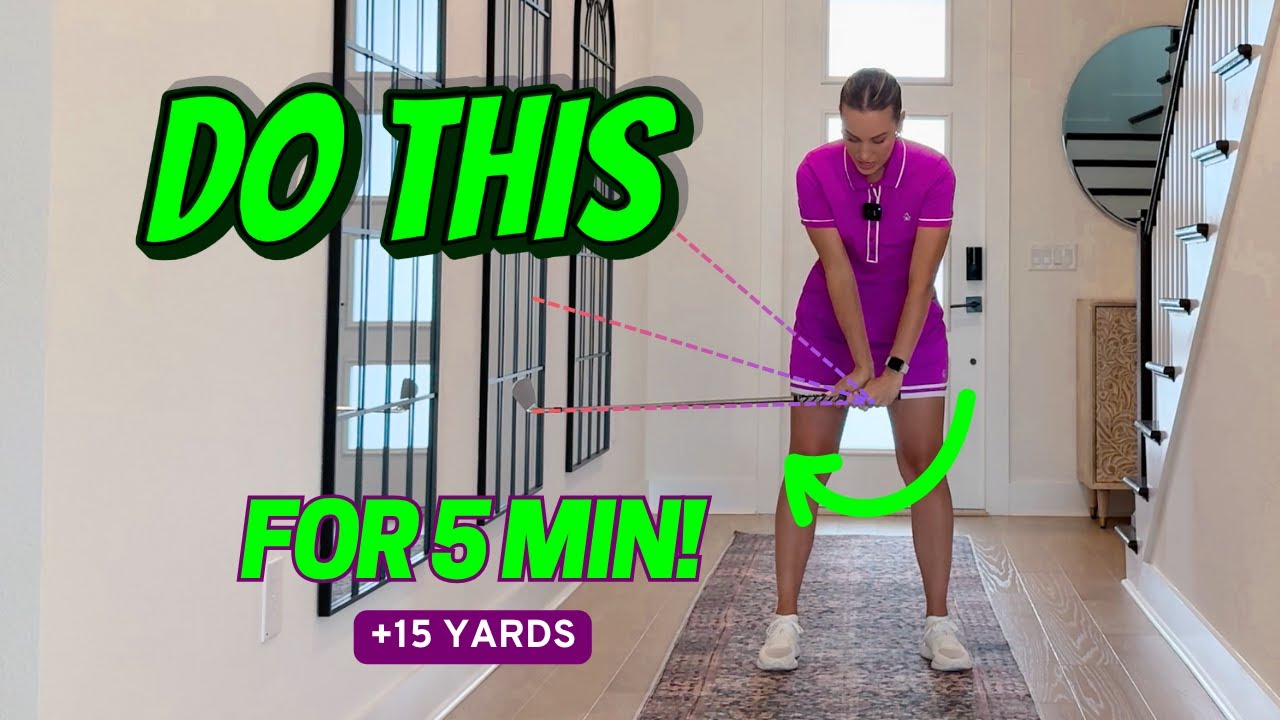
Why the first move matters
When the trail elbow folds first, the wrists never set. The club head stays low, the face is hard to control and you're left in a lifting position.
From there you have to catch up with your timing, the club face and your angles in a split second. Nobody can do that consistently. Get the first quarter of the swing right and the club can simply swing.
“An open palm is an open face.”
Coach Carolin, in the lesson at 5:06
The one-piece takeaway and set drill
Righty: take the club head back to 8 o'clock.
Lefty: take the club head back to 4 o'clock.
- Check your grip first. A very strong trail-hand grip makes it hard to hinge correctly.
- Take the club back in one piece: belly button and the butt end of the grip turn together, hands just outside your trail thigh, no wrist hinge yet.
- At 8 o'clock, set your wrists up as much as you can. Look for small wrinkles on the back of your trail wrist, with your trail palm facing down, not up.
- From there, turn up to the top, then swing through and hold your angles as long as you can.
- Use an 8 iron, a 9 iron or a wedge. Don't go longer than a 7 iron for technical work on the range.
Don't start your real swing with your wrists. The one-piece takeaway comes first, then the set. That's the change Carolin makes to the popular version of this drill.
How you know it's working
The club head moves up and the face stays square at 9 o'clock.
Your trail elbow folds after the wrists set, not before.
Iron strikes feel solid without trying to catch up in the downswing.
Free: Full Swing Cheat Sheet
Carolin's key positions on one page, for the range.
Key takeaways
Connect firstBelly button and grip turn together to 8 o'clock.
Then setHinge the wrists before the trail elbow folds.
Watch the palmAn open palm is an open face.
Short clubsDrill with an 8 iron or shorter.
Questions golfers ask
What is a one-piece takeaway?
Your belly button, arms and the club move back together, with no wrist hinge, until the club reaches about 8 o'clock and your hands sit just outside your trail thigh.
When should the wrists hinge in the backswing?
After the one-piece takeaway, at about 8 o'clock. The wrist set comes before the trail elbow folds.
Why does my club go behind me when I hinge?
Usually the trail hand is too far under the grip. Fix your grip first, then hinge up from 8 o'clock.
Not sure your takeaway is the cause?Tell Carolin what your ball does and get your personal fix. Free.
Find my missRead the full video transcript
Auto-captions, lightly edited for names and golf terms.
Hi golfers and welcome. I'm Coach Carolin and today we're going to talk about how you are going to pick up distance immediately without having to pick up any strength or muscle. If you guys are looking for more inerson instruction or any of my other programs that I have, please feel free to check out the description box. I have all my links and all my programs down there. I'm also launching a brand new program next week. This week, next week, really pretty much now that you guys can already learn more about. So, I'm popping that link below as well. So, this is an elite program that's usually reserved for my tour pros and my elite juniors, but now I'm bringing it to you guys with a partnership, which I'm super excited about. So, make sure you head down there and check it out. All right. How can we pick up distance pretty much immediately without having to go to the gym or feel like we have to invest a ton of time other than a little bit of work on the range. We can do that by using the club more efficiently. And when I say more efficiently, I mean just how the weight of the club head moves in your back swing and in the very beginning of the swing specifically. And I see this so much in my students. I'll show you what I see. And I see this pretty much, I would say, in 80% of the people, especially when they struggle with their iron strikes and with their iron contact. So, if you're somebody who struggles with your contact on your irons, this is the tip you need to watch because I can assure you you're doing this. So, here's what I see a ton. They will set up, they'll have a pretty decent setup, and then as they go back, what folds first? Which joint do you see kind of folding first? That's right. It's the right elbow or the trail elbow. And then what happens from here is that there is no wrist set whatsoever because the elbow has set first and then the wrist set never comes because the wrist set is usually the first thing that will happen in the back swing from a hinge perspective and set perspective and that will control the club face. It'll control kind of how the momentum of the club. See how when I actually allow it to set, how much more the club head can actually go up in relation to the ground versus if I do it with my elbow. And my elbow, my club just stays pretty much straight and my face tends to kind of stay pretty shut depending on the grip that they start out with. But it's really hard to have any face control with this. And then here, now you're in a lifting position. Now all you can do from here is lift. So you you have essentially been really inefficient from the get-go. And what does that do for us? It compensates. And now we're trying to catch up with our timing. We're trying to catch up with our club face and with our angles towards impact. And we're trying to do all that in a few split seconds, which no matter how good you are, how athletic you are, there is no way that this can ever be consistent. That is why we need to address the set. And I will give you a drill. Make sure you watch this video until the end so you can have this drill because it's a little modified. I've seen this drill floating around online quite a bit right now, but I'm not a huge fan of how it's done. Um, so I want to modify it a little bit to make sure that there is not another mistake that you're kind of making when you're training this drill. So, make sure to stick around. So, in an ideal case, we want to make sure that we have a one piece takeaway. And I've reiterated this in so many of my videos. You guys are probably sick of my one piece takeaway at this time, but trust me, you will not be sick of it when you're hitting the ball really well. So that's just going to leave that right there. Now when we go back, the one piece takeaway is super important, right? This starts your swing off together. So connection is what creates power, what creates distance and consistency. So staying connected is really important, but what's even more important is getting connected. And getting connected happens here. Staying connected happens in a downswing. So, but when we get connected, guess what? Staying connected is a ton easier already. So, making sure we get connected. Belly button and butt end of the grip will face each other until 8:00. This is 8:00 with my my club head. And now, what will happen from here is we're going to start setting our wrists backwards. And this is difficult for people that don't have a good grip. So, make sure you head to my grip video because if you are somebody who has a very kind of strong right hand, which means it goes underneath the grip a lot and you actually kind of don't have a good grip in your right hand, it's going to be difficult for you to hinge back. So, if you do have a very strong trail or right hand grip in this case, if you go to 8:00 and then you hinge, what happens? The club will go behind you. We don't ever want to be here. I call this golf jail. I have a video about golf jail as well and how to stay out of it. If you're interested, I'll link it below. Um, so this is not what we want to do. We want to make sure we start with a good grip, assuming we have a good grip. We get to eight o'clock with a one piece takeaway. Then we hinge up. And we want to kind of see these little wrinkles on the back of our wrist right here. That's what we want to see. We don't want to kind of have the wrist kind of roll open and have our palm facing up. See what that does to the face? The face is now open. An open palm is an open face. a nice palm that looks kind of down to the ground with little wrinkles on the back here on the right hand side. This is what gives us a really good club face right here in this nine o'clock position. Now we have set the club. We can use the momentum. One piece takeaway set. One piece takeaway set. And now the elbow comes and starts hinging. So now as a full motion it'll look like this. And then you have all the angles set. So now it's just a matter of getting your big muscles turned through and getting your chest to point pretty much at the ball at impact and then just releasing that club through. So do you see now how important the first quarter of your swing is? If you can get the first quarter of your swing correctly, you have pretty much done 90% of the work because now your club can move, your club can swing, and you're not forcing it into positions from the get-go, which that is what keeps 95 99 most players from playing really well because that is what keeps 99% of players from playing their best golf because they don't get off to a good start and because They don't know how to efficiently let the weight of the club head move in the back swing. So, they're playing catch-up in the down swing. All right, so let's look at the drill that I was referring to before. So, this drill, and I see this a lot, um, currently it's a trend. It's a trend, guys. So, we're sticking with the trend, but we're modifying the trend because I'm not somebody for trends. Trends should only be trends if they're actually relevant and correct. So, and I'm not saying this is incorrect. I'm just saying I feel like it skips a couple of pieces and there might be other problems that you're developing if you're just doing it the way that I've seen it done. So, I've seen this drill where you kind of set up and then you hinge backwards like this from set up and then you turn up and you turn down. That's the drill I've seen. I don't dislike this drill. I think there's so much good in that because it does help with that wrist set. It does kind of in, you know, really kind of re-emphasize what I was talking about those little wrinkles on the back of your hand. It prevents rolling. It really sets the club and then it kind of like just allows you to bend the elbow later on and really kind of gets ahead of the game with the wrist set. However, what I don't like about it is that it doesn't have the one piece takeaway. And what I wouldn't want to see you guys do is start your golf swing with your wrists because you don't want to do this. Your actual golf swing does not need to be started or should never be started with your wrists. So, we don't want to get to a point where we've done this drill so much that now we're doing this. And I I've seen this like kind of push hands forward and and kind of hinge right from the get- go. Not a good idea. You get very disconnected and it's a tough one because then your body doesn't actually start moving. So, how I suggest you guys do this drill and integrate it into your swing is you go to 8:00. You do the one piece takeaway right here, just about where your hands are right at the outside of your right thigh and you haven't hinged anything. This is just belly button movement. Everything's still in a straight line. You can see this here. See, my belly button moves back. Hands are just on the outside of my right thigh. There is no hinge in my wrists. But then once I am at that 8:00 position right here, now I want you to do this. Now I want you to set the club as much as you possibly can and then turn up and then we go through and we keep those angles right about, you know, as long as we can really. You can do this with a pitching wedge, with a nine iron, with an eight iron. I don't ever recommend for you guys to go higher than a seven iron if you're doing anything technical on the range. And if you're doing drills, my eight iron, which I have right now, is my best friend for technical drills, but you can choose whichever one you prefer for that as long as it stays under your seven iron. So, that's the drill that I would recommend you do if you're struggling with your iron strikes. It's really, really going to help you with your wedges. It's really going to help you with your irons. Just make sure you definitely apply that little modification that I gave you because it's going to prevent you from developing some other problems in your swing and keep you on track to improvement. Thank you so much for watching, guys. Let me know in the comments below what you want to see next. Always subscribe, maybe even hit the notification button so you know when I drop my next video. Leave me a comment, like the video. I so appreciate your time and keep practicing. [Music]

Coach Carolin (Carolin Pinegger)Former tour player, Leadbetter Certified Instructor, GolfPass instructor, Golf Channel's Big Break. Millions of golfers follow Coach Carolin's lessons.