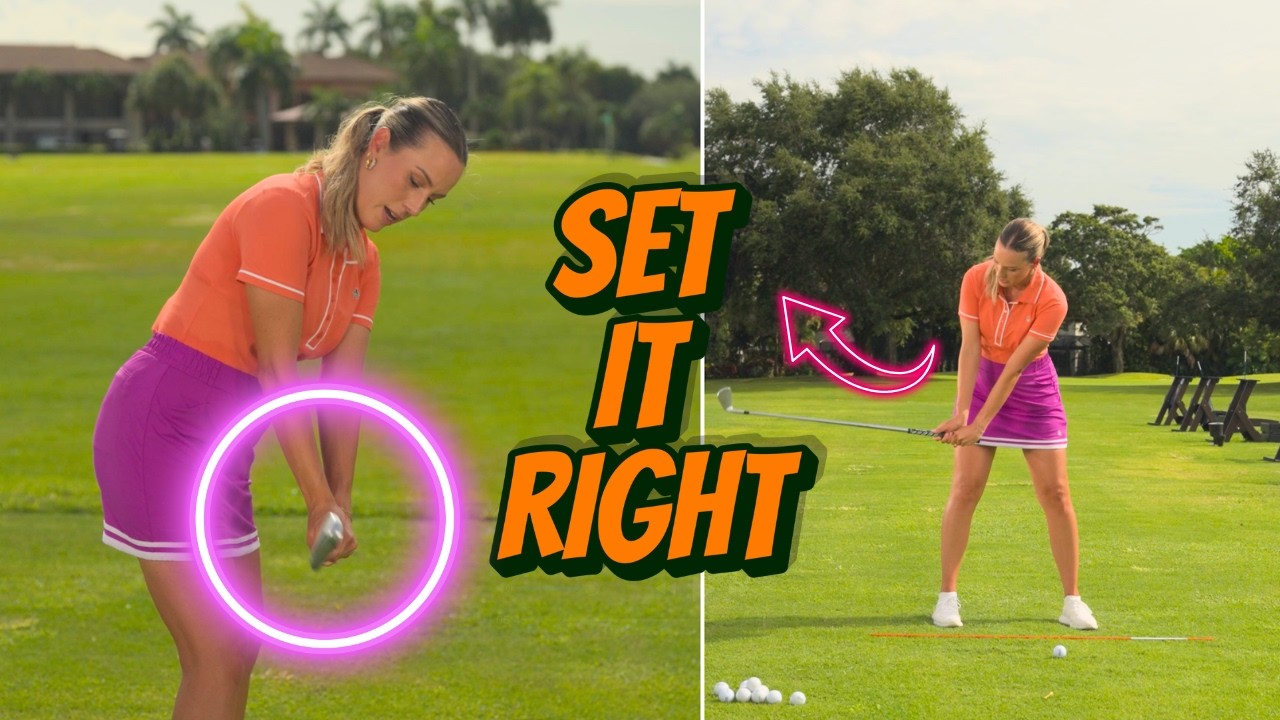
When the trail elbow folds first, your body thinks the folding is done. All that's left is to lift, and the club head loses its momentum.
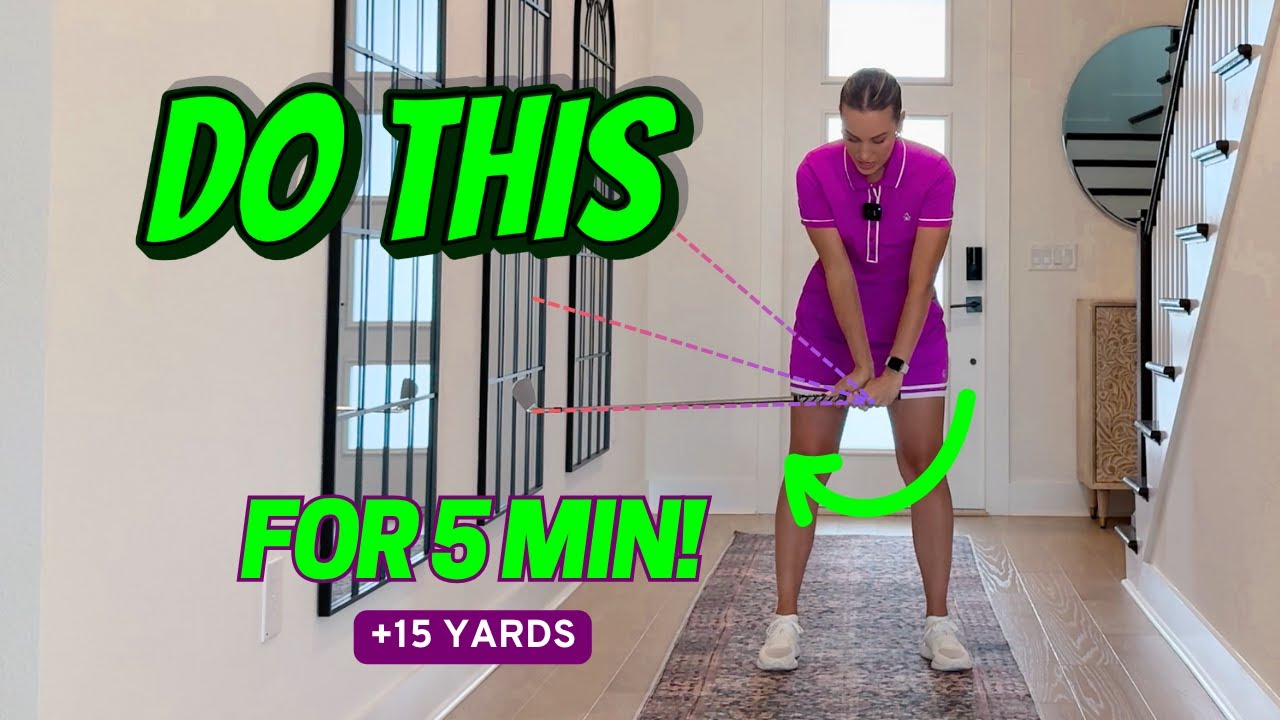
There's a weight at the end of the shaft. Swing it like a pendulum and gravity helps you. Set your wrists after a one-piece takeaway and that momentum turns into speed.
Read the full video transcript
Auto-captions, lightly edited for names and golf terms.
Hi performance golfers. I'm Coach Carolin and today we're going to talk about a little distance hack that's going to allow you to pick up about 20 yards today. If you can do this without going to the gym, without feeling like you have to muscle the ball, anybody can do this no matter how old or how athletic you are or you are not. So, let's jump into it. All right, guys. So, this goes back to a pattern I see on so many of my students in my clinics, in my lessons, in my online videos. So, this is what happens a lot of the time and that kills your distance. This is really one of the biggest keys of why you're struggling with distance, why you're struggling with consistent contact. And it happens, shockingly enough, right at the start of the golf swing. So many things can go wrong within two feet. You have no idea. But that's why we're here. So you can catch the idea, right? So first thing that I see and you guys are going to see this down the line the best way is the first thing that folds, the first joint that becomes active right here. You guys take a second, watch me do this. See if you guys can see. Right? What's your guess? Leave it in the comments if you have one. It's my right elbow, right? My trail elbow that starts to bend right here. This. So, the biggest problem with this, it doesn't allow us to get wide in the back swing. See how I'm kind of attached very much to my right side, to my trail side. I'm not actually getting any width in my back swing. And the other problem it creates is that our bodies are very smart, guys. You guys are smarter than you think. Here's the good news. But the problem is it doesn't always help us because this is the second our elbow folds, our body thinks that we're pretty much done folding and all you can do from here is lift. So you'll be here and then you'll be lifting, right? And when I do this, you see how I have completely taken out the momentum of the head of the golf club. And guys, there's a weight at the end of this, right? There's a weight at the end of this stick. Could be anything. It could be another just a stick with a stone on it. It could be anything other than the golf club. But do you see how when I swing this back, you see how now if I do something just very simple like a one- arm swing that the actual head of the club head goes up, right? This is momentum, guys. This I don't have to force it. I'm just getting it started, but I'm not forcing it. It's kind of like a little pendulum that goes up and it'll come down. We're using gravity. When you don't do this, when you actually just pull your right elbow in and you hinge that as a first as a first motion, you have completely disarmed this because now you'd have to actually lift to get it up. And then we really go into territory we don't want to be in, right? We're lifting. Sometimes that gets us out of our spine angle and we're just very much struggling with good contact and with using that momentum because we've never built it, guys. You have completely made it as hard as possible for you to build momentum. So, how do we build momentum, guys? We got to make sure that it starts with a good wrist set. So, you've seen people set their wrists, tour players set their wrists really well. There's ranges of how much or how little people set their wrists, but they all set them because they need that momentum right here. They need this. And if you guys want to grab your club with one hand, with your trail hand, and just do this, I promise you, if you're doing what that what I was showing before, if you're doing it wrong, you're not actually using that momentum of the club head and that weight of the club head. So, making sure, a couple things. Making sure that your trail hand isn't too far under the grip. If your trail hand is kind of like this, if the palm's kind of facing forward, if you opened it and your right hand, right hand's under, left hand's over, like super strong grip essentially, that makes it really hard for you to hinge your wrists because if we were here and we would hinge, we would actually hinge behind us. I call this golf jail because if you're in there, you're on your own. You got to bail yourself out somehow. But it's really hard. Not very many people get out of it. Only the the really smart ones, guys. So, let's not go back here, okay? Let's not have to hinge this way. And because we don't want to hinge this way, people lift, right? So, let's make sure our grip is fixed and our trail hands actually nicely on top of the grip right here. I kind of want you to feel like if you were to ring out a towel, if there you had a wet towel right around your grip, I want you to feel like you're ringing that out. You would never ring a towel out the same direction. You wouldn't be very successful, right? So, let's feel like you're ringing that towel out. You're working your hands together. Then, you're coming down here. And now we're going to eight o'clock. That's just outside your right thigh. And now I want you to feel like you're letting that right wrist set back and up. I want you to really feel like you're seeing these little wrinkles on the back of your wrist. And then you can use that momentum of the club head to come up. So do you see how much further my club head now can move up away from the ground versus this way? Now, if I'm hinging, it's really hard for me to get that club head up. No momentum, ton of momentum. No momentum, ton of momentum. Right? So, it all starts with the grip and the actual sequence. You allow your joints to set. So, this gives you width. This gives you power and it gives you momentum of the weight here. Because that's the whole point, guys. We got to make sure that we use this weight, right? Otherwise, why do we have a why is it weighted? Why? Why can't this be just the same weight as the rest of the club? Why does this have to be heavier? Because we should use it, right? Simple enough. So, let's really feel like you go to 8:00, you hinge, and you turn up, and then you're up here, guys. That's it. It's so simple. One piece takeaway. Hinge, turn up. Super simple. And I've seen this tip online that's going around that's trying to help you do this better, which is goes like this. And we're going to do a little modification on this because I'm not a huge fan of this way it's done. They start here, then they hinge, and then they rotate up. So, I get what that's trying to do. Problem with this is that you might actually create some more issues before you fix the one you're trying to fix because I don't want you to actually get handsy in your takeaway. I don't want you to do this right from the takeaway. My modification that you just saw here before in a little bit is go to eight o'clock one piece takeaway. I know you guys are so sick and tired of me talking about my one piece takeaway. And when I say the one piece takeaway, I mean the belly button being aligned with the button of your club until 8:00. And then you hinge as hard as you can. You're going to feel a little restriction in your wrist on your right wrist if you haven't never done this before. And then you turn up and then you feel like you're keeping that angle, right? That is totally fine. But let's not skip that first foot of the golf swing, which is that eight o'clock position. Nice one piece takeaway, then you hinge, then you turn, then you go. Let's look at the sequence one more time. One piece takeaway, hinge, turn, go. That's the adjusted drill that I want you guys to do. Not right from the get- go, but from 8:00. So, let's hit a little shot here. And I recommend you guys do this with a short iron, like 9 iron, 8 iron. I have an eight in my hands because that is the club I love to do technical work with. And we're going to feel a little bit more compression on this. We're going to feel better contact and most importantly just more club head momentum. Okay. Oh, it was such a nice little draw. Really feel like those wrists go back. They can set that weight of the club head goes up and then it travels down with gravity. Now we're not fighting gravity anymore, guys. Fighting gravity has never been a good idea in the history of humankind. It doesn't work very well. Gravity is about as consistent as it gets. So, why not work with it, right? All right, guys. I hope you guys love this tip. I hope you learned something. Subscribe to this channel. Leave us a comment below. We're always here to answer your questions. Thanks so much for watching. [music]