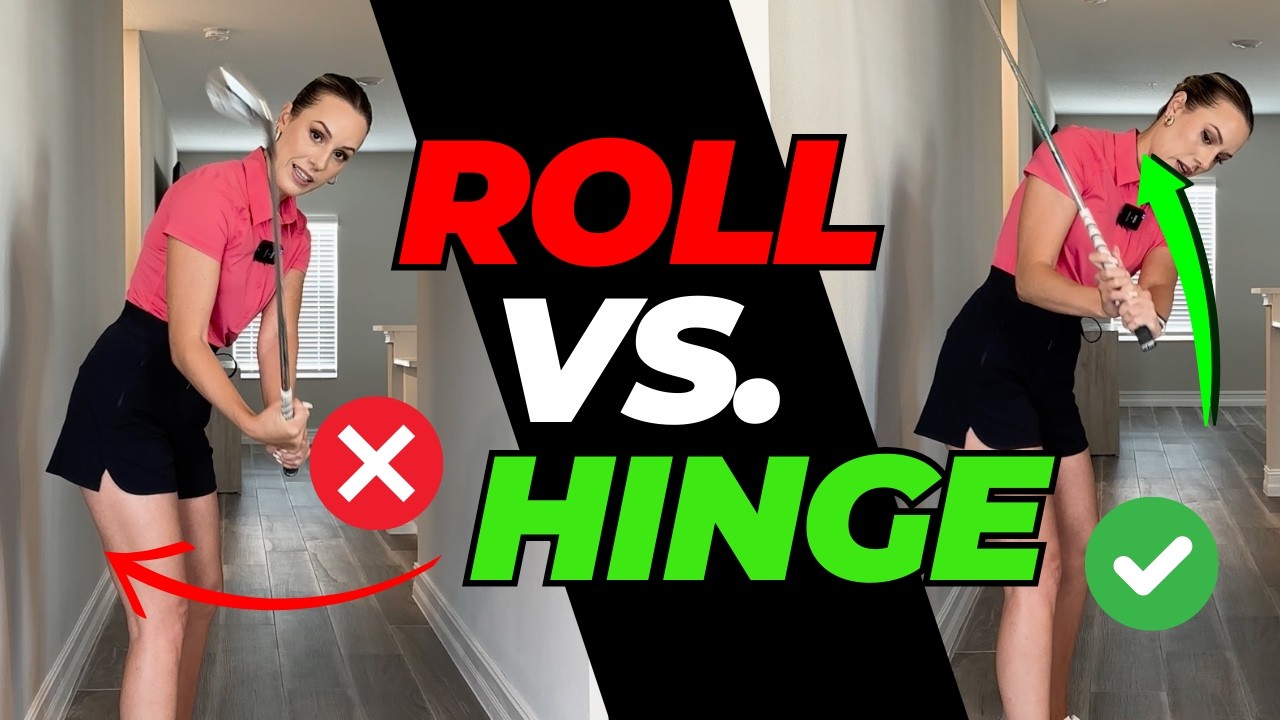
Why your setup controls your turn
Stand straight and turn, and you can turn a long way. Tilt forward and turn, and the shoulder plane gets steeper and the turn has natural resistance.
Golfers who sit back on their heels end up upright with a flat shoulder plane. Nothing stops the turn, so the club keeps going. The right tilt puts your weight over the balls of your feet.
“the shoulder plane determines how you can actually turn”
Coach Carolin, in the lesson at 0:51
Stand tall and tilt
- Stand up straight with the club.
- Tilt your shoulders forward from your hips. Don't push your backside back to do it.
- Let your arms hang. Your weight moves to the balls of your feet, not your heels.
- Rehearse the turn: lead shoulder goes under your chin and over your trail foot.
- Brace your trail leg so your shoulders turn about 90 degrees and your hips about half that.
How you know it's working
Your weight sits over the balls of your feet at address.
Your backswing stops by itself, without you trying to swing shorter.
Your lead shoulder ends up over your trail foot at the top.
Free: Full Swing Cheat Sheet
Carolin's key positions on one page, for the range.
Key takeaways
Plane decides the turnFlat shoulders turn too far.
Tall, then tiltFrom the hips, not by pushing your backside back.
Balls of your feetNot your heels.
Over the trail footThat's where the lead shoulder goes.
Questions golfers ask
How do I stop over-swinging?
Fix your setup first. A forward tilt from the hips gives your shoulders a steeper plane that stops the turn naturally.
Should my weight be on my heels at address?
No. Over the balls of your feet. Sitting back on your heels flattens your shoulder plane.
How much should I bend my knees?
A little. A lot of knee bend usually comes with sitting back and an upright upper body.
Not sure your setup is the cause?Tell Carolin what your ball does and get your personal fix. Free.
Find my missRead the full video transcript
Auto-captions, lightly edited for names and golf terms.
hi everybody and welcome to today's session and today I want to talk to you guys about how we can naturally stop overswinging without having to do anything else than a simple setup change all right you know me your girl likes to keep it simple so this tip is really centered around one slight change in your setup it has nothing to do with a ton of Swing thoughts nothing to do with being complicated as you're swinging and it's just going to naturally stop your overswing I mean who doesn't want that even myself I have had some times in my career where I just over swung and I look at the video and I'm like how am I swinging so far and then I'm trying and I'm trying to stop and not overswing but and I feel like I'm halfway back but I'm still like halfway too far so I feel you I've been there I've done that and the best solution I can offer you is what I found out for myself what I do for myself when I compete when I play it so this stuff works let's jump into it all right so the shoulder plane is the biggest piece here in this equation because the shoulder plane determines how you can actually turn so let's talk about shoulder plane so this is the shoulder plane that I'm talking about and this is easier for you guys to see down the line here so this shoulder plane if I'm turning it it stays the same and it's a very flat shoulder plane right if I'm now tilting like I am in the golf swing and I'm now turning see how that shoulder plane kind of goes a lot steeper so a really steep shoulder plane is obviously this where the club gets more you know what is this perpendicular I think to the ground and then if you have a very flat shoulder plane it would be this in the golf swing where it's absolutely parallel to the ground so we want to be right in the middle of those two ideally and what happens with a really and I'm going to put this away because my walls need to be clean and not hit because we're moving as you guys have figured that out um maybe by the time you see this video we've already moved but right now we just fixed these walls now is not the time to hit them Carolin not the time so now when I show you the shoulder plane if I'm just standing up straight I can turn I can turn pretty far I'm pretty flexible but anybody really could you guys try this you can turn pretty far bending over and I'm doing the same thing and I'm starting to turn really flat I can also turn a lot more and it really is there's no resistance for me I can turn and if I added my hands here I mean my club would be you know coming out here so the first thing I want you to do to create the perfect setup with the perfect shoulder angle and shoulder plane is this you stand up straight and then you feel like you're bending and tilting your shoulders forward we're not pushing our behind back we're just moving our shoulders forward at the hip see this I'm turning I'm not turning I'm tilting I'm tilting I'm tilting and now I'm going to let my arms hang and what this did is it actually moved my weight over the balls of my feet right here which is perfect it's exactly where you want it you don't want it in your heels when people struggle with too flat of a shoulder plane what usually happens is they kind of sit back on their heels like this and have a lot of Bend in their knees which we want to avoid because now see how I'm kind of if I do it the wrong way see how upright I am here and what does that do it really allows me to do the wrong thing a lot easier and swing back in a really flat shoulder plane so now that we've learned how to set up correctly first and how to get that tilt correctly again we're standing up and now we're actually bending the shoulders over not the not the behind being pushed back just bend your shoulders forward you're going to feel that weight shift a little bit into the balls of your feet like we said hang the arms perfect now from here we want to just tilt get that left shoulder down but feel like you're moving it over that right toe so from my perspective you can't see this from your perspective but from the golfer's perspective and from your perspective in your swing you will feel like that front shoulder as you're getting it under your chin is going to go over your Trail foot and that really helps us with the upper lower body separation let me show this from face on right here so we have our setup we're tilting at the hip not much knee Bend we have our weight in the B of our feet and now we're we're tilting and turning at the same time so turn comes from the feeling of getting your your lead shoulder over your Trail foot and the Tilt comes from feeling like you're doing it by rotating the shoulder under so it's under the chin but over that trail foot and that's the perfect shoulder rotation right here and I'm keeping this foot pretty braced if you can see it's pretty BRAC into my hip now my hips turned about 45 Dees my shoulders are turned 90 and that's going to naturally stop your overswing because we're not built our spines are not built to do this excessively if we are in that correct angle and setup so again not much knee Bend Bend at the hip shoulders over weight in the in the balls of your feet right here and now we're feeling like we're getting that left shoulder that lead shoulder Under and Over that trail foot and here we go honestly I there's no way I'm going to turn any further I can't like this is going to take my back out if I try and this is all you need this is a full turn and you're going to feel so much tension you're going to be feel so much good resistance good tension not bad tension but some people are going to have to get used to this because they're usually like Loop this is great I can take the glub back so far you don't want to do this so make sure you go through that super simple setup change and it's going to stop your overswinging naturally nothing else that needs to be doing guys I hope you enjoyed this this is an awesome awesome tip I love this it's really simple it's all the big muscles we want to make sure we focus on the big muscles on the core on the shoulders not the arms because you know we're not cre these guys aren't creating emotions the arms are attached to the body in an ideal case that is the case and we want to make sure that we're changing the big muscles so try it out next time let me know in the comments below how you liked it and how it changed your swing I'm sure it will and we're going to stop that over swinging and we're actually going to gain yardage with that I see you guys next time oh

Coach Carolin (Carolin Pinegger)Former tour player, Leadbetter Certified Instructor, GolfPass instructor, Golf Channel's Big Break. Millions of golfers follow Coach Carolin's lessons.