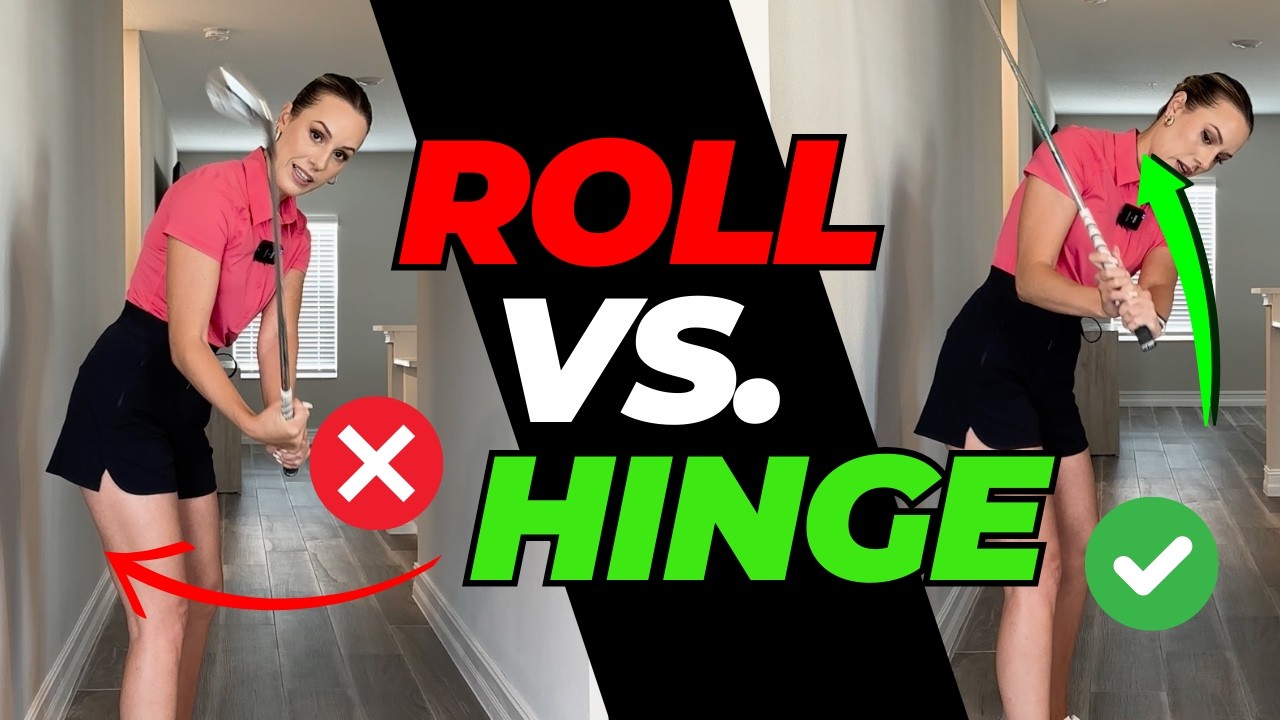
Why your spine angle matters
Your spine angle gives you a stable center to turn around. When it changes, the club has to find the ball from a new position, and that costs you contact.
Golfers lose it in two ways: changing it going back, or turning well and then coming out of it on the way down. The shoulder drill shows you both.
“you should be in the exact same position that you started from”
Coach Carolin, in the lesson at 0:16
The shoulder turn drill
- Take your setup and feel your spine angle. A club along your back shows it.
- Slide an alignment stick through your shirt across your shoulders so you can see its ends.
- Turn back: the lead end of the stick points down toward the ground, lead shoulder under your chin.
- Turn through: the trail end points down, trail shoulder under your chin.
- At home without a stick: cross your arms over your chest and do the same turns.
How you know it's working
In the backswing, the lead end of the stick points at the ground, not up in front of you.
After impact, your trail shoulder is under your chin.
You don't stand up through impact anymore.
Free: Full Swing Cheat Sheet
Carolin's key positions on one page, for the range.
Key takeaways
Same angleFinish the swing in the spine angle you started with.
Lead shoulder downIn the backswing, under your chin.
Trail shoulder downIn the downswing.
Two ways to lose itGoing back or coming down. Check both.
Questions golfers ask
What is spine angle in golf?
The forward tilt of your spine at address. You rotate around it instead of changing it.
Why do I stand up in the downswing?
Often you change your angle going back, or you lose it coming down. The shoulder drill shows you which one.
Can I practice this at home?
Yes. Cross your arms over your chest and turn: lead shoulder down going back, trail shoulder down coming through.
Not sure your posture is the cause?Tell Carolin what your ball does and get your personal fix. Free.
Find my missRead the full video transcript
Auto-captions, lightly edited for names and golf terms.
welcome everybody to today's session with myself Coach Carolin I'm a Leadbetter certified instructor and a former professional Tour player and today we're going to talk about spine angles and your head position and where you should be with those throughout your swing and it's really not a very hard answer you should be in the exact same position that you started from so maintaining those angles and positions throughout your whole swing giving yourself a very very stable Center to turn around in your swing is key here and I'm going to show you what I mean by this so what I mean by spine angle is the angle that your spine is tilted on at setup so I'm going to show you this put my club right on my back this is my spine angle right you don't want the spine angle to be changing as you're going back or as you're going through a lot of people do this they go back nicely and then they do this and they stand up out of it and either you've done this before you've seen somebody do this because I sure have and I've sure done it too so we want to learn how we can actually rotate around this spine angle throughout the entire swing without changing this as we're going I'm going to show you this from the front as well so you want to make sure that you have that spine angle in the back and that you're rotating around it like this with your body versus changing this in the back swing or changing this in the down swing as you're standing up so now that we've understood what a spine angle is let's give you a really simple drill of how you can fix this and make sure that that spine angle stays the same personally I love to reference my shoulders so with my shoulders and I like to take another alignment stick here so give me a second we're going to grab another alignment stick and what I like to do is to actually put it right through my shirt right here so this is really going to resemble and give you a reference for your shoulder plane see how if I change my shoulders you can see this in the corner of your eyes so that's what we're going to be looking at so you want to make sure that when you're swinging that left shoulder and that left part of the alignment stick starts to point down towards the ground see when I'm standing up and I'm changing my spine angle it actually points up in front of me or even to the sky hopefully nobody does this but you know crazier things have happened so you want to make sure that as you're rotating you actually turning that left shoulder down and then in the the down swing you're doing the same thing you're turning your right shoulder down the more common mistake I see well you know actually I don't know if it's more common it's probably 50/50 that people either change their spine angle going back like this and that shoulder plane goes all wacky and this one points more down to the ground and the other one being you're up here you've turned nicely and then you come out of it and this is when you know things really go wrong so some sometimes people kind of maintain that shoulder angle and just kind of go forward and that right shoulder never quite gets underneath your chin so I love to just feel this end of the alignment stick down and then this end of the alignment stick down this end down this end down so I'm going to put this down here so it's nice and put away and we want to make sure that you can also do this without a club simply cross your arms around here this is good for at home you don't need to be on a range or on a golf course for this turn back having that left shoulder Point down keeping it underneath your chin not above and then turning that right shoulder down left shoulder down right shoulder down and that is all the magic guys so this is a great drill for offseason for inseason you can use an alignment stick or you can also just use your Club putting that across your shoulders doing the same thing pointing this end down pointing that end down this end down that end down all right everybody so if you struggle with keeping your spine angle the same throughout the swing this is the simplest tip you can do and I'm really excited to see your golf [Music] swings

Coach Carolin (Carolin Pinegger)Former tour player, Leadbetter Certified Instructor, GolfPass instructor, Golf Channel's Big Break. Millions of golfers follow Coach Carolin's lessons.