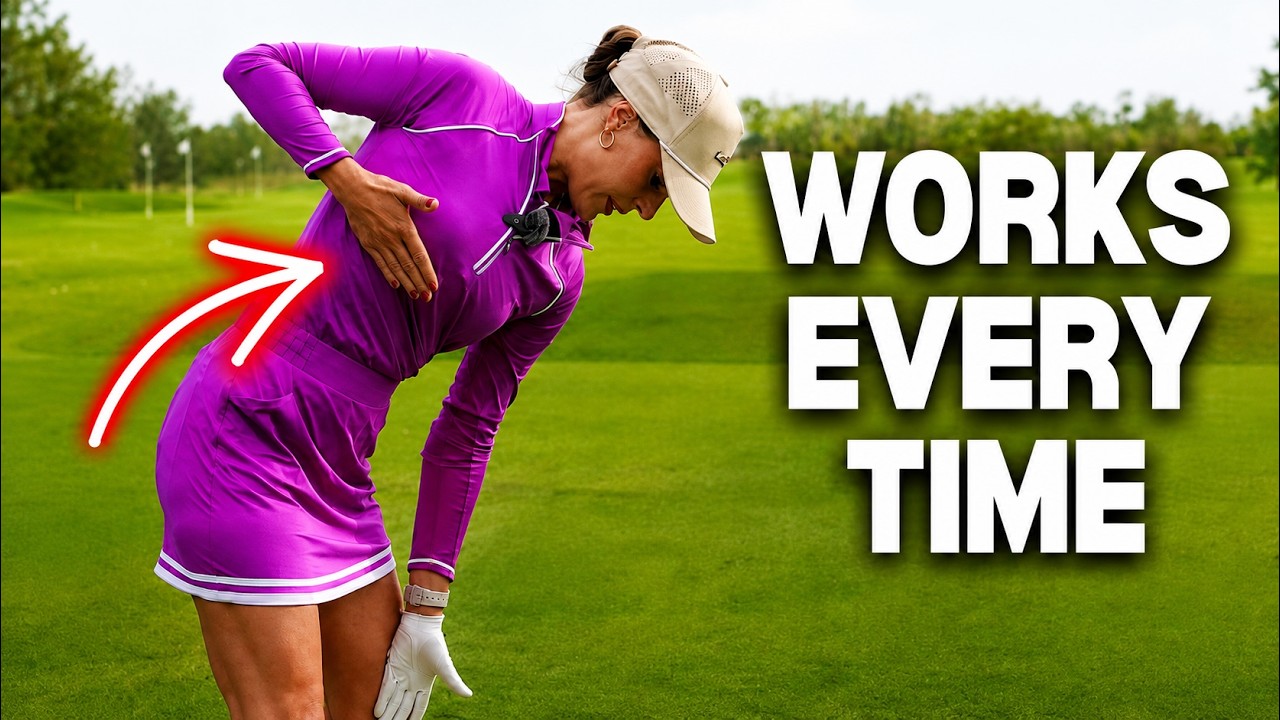
Why swaying ruins your contact
The more you move away from the target in the backswing, the more you have to get back to where you started. That depends on timing, and timing changes from day to day.
A centered backswing keeps the low point of your swing in front of the ball. Ball first, ground second. That's the compressed strike you're after.
“We don't want to feel like it's drifting away.”
Coach Carolin, in the lesson at 3:03
The wall drill, step by step
Righty: wall or stick on your left side.
Lefty: wall or stick on your right side.
- Set up with your lead side next to a wall at home, or an alignment stick in the ground on the range.
- Make a backswing. Feel your lead knee and lead hip press toward the wall while your trail hip turns back. Your lead knee can move forward, not toward the target.
- Watch the small gap between your lead hip and the wall. It shouldn't grow.
- On the range, hit tiny baby swings of 30 to 40 yards against the stick and exaggerate the centered feel.
- Rehearse a backswing to the top at the wall, reset, then hit a normal shot.
This is an exaggeration drill. If everything sways away from the ball today, you have to feel the opposite to change the pattern. Then go hit normal shots.
How you know it's working
At the wall, the gap between your lead hip and the wall stays the same all the way to the top.
Your strike comes ball first, ground second, without saving it with your hands.
Fewer fat and topped shots, because your contact no longer depends on timing.
Free: Full Swing Cheat Sheet
Carolin's key positions on one page, for the range.
Key takeaways
Stay centeredSwaying makes good contact depend on timing.
Low point in frontCentered means ball first, ground second.
Lead knee can moveYour lead hip never sways away from the target.
Exaggerate, then playUse the wall feel, then hit normal shots.
Questions golfers ask
Should your lead knee move in during the backswing?
It can. Many great players' lead knee moves in a little, but their lead hip doesn't sway away from the target. The hip stays fairly centered.
Can swaying cause fat and topped shots?
Yes. When your hips drift away from the target, the low point moves behind the ball. You hit the ground first, or the club rises and catches the ball thin.
Can I practice this at home?
Yes. Any wall works. Stand with your lead side next to it and rehearse backswings without letting the gap between your lead hip and the wall grow.
Not sure swaying is your cause?Tell Carolin what your ball does and get your personal fix. Free.
Find my missRead the full video transcript
Auto-captions, lightly edited for names and golf terms.
In the back swing, what we do see a lot of players struggle with is really kind of drifting it away from the target. And in relation to that, we would generally see the hips sway and even the upper body. And by the time they get to the top of their swing, they're just well behind the golf ball, aren't they? Yeah, absolutely. And it just takes you away from the target. If you think about it, the more you move away from the target in the incorrect way in the back swing, the more you're going to have to be forced to try to get back to where you started. And that is very timing dependent. So if you wake up and everybody does this, everybody wakes up differently. If you ask yourself, what's the difference between Rory shooting, you know, 65 versus a 75? The guy's swing didn't change overnight. He feels differently. Everybody wakes up feeling differently. And timing is what we try to take out and the dependency of timing. We try to take that out um with the technically sound swing. Yeah. So when you can make sure you get a better stability in your lower body, you don't have to make up that distance and hope that your timing feels good that day. Great. So what I want you to do is set up to a ball here for me. And for the players at home, we're actually going to demonstrate a poor version of this. Now, what we can do as Carolin stays in this position here, if you begin to slowly swing down towards the ball for me, we're going to see that she's well behind the top of the golf ball. If we were just going to draw a a line directly up from that golf ball. Now, what we would see from here is strikes that would hit the ground too much. Club might rise and hit the equator of a ball thin or just top a couple of feet in front like that. This is what we were doing before we started. So once let's say those players do get themselves into that position and their lower body is swaying away from the target a lot. They're struggling with their strike. Uh the concept of low point or getting the bottom of the golf swing further in front of the golf ball, striking the ball first, the ground second to get that real compressed strike that players looking for. Uh what's a feel and what's maybe a drill that you have and you teach players that would ensure that they're staying more on top of the ball? Yeah, absolutely. So, as you know me, I do a lot of my content in the hallway. And I love this actually for people because as we all know, when you put a ball there, things change. Yeah. Things become very different very fast because instantly your mind goes, I want to hit this golf ball, not I want to swing the golf club correctly and the ball should just be in the way. And I'm sure you've heard this. Everybody kind of heard that being said. So, what I like to do is when you have a wall at home and you don't even necessarily need a hallway. A wall will do just fine. And when you're out here, you can put an alignment stick into the ground right here, which is what I like on the range. And then as you're taking it back, you want to feel like that that left knee or lead knee in your case is not that in it's not really increasing and your hip that little gap here isn't getting much bigger. You want to make sure that you did you do load and your right hip does turn back. If anything, your knee goes forward, but engaging that knee and engaging the right muscles to feel like they're pressing into this shaft or into this wall or into this alignment stick is what we want to feel. We want to feel this. We don't want to feel like it's drifting away. So feel like you're pressing that into the wall towards the target and your knee is not going to go towards the target. It will go forward which is much more correct. It's going to stabilize your hip and as you said make sure that that low point stays just in front of the ball. Correct. There is going to be a lot of players who are watching this and go well we see a lot of the best players in the world. The lead knee actually goes slightly in as they take the golf club back. What we're doing here is giving you an exaggeration feel, which is very important for players to move to change your pattern. If you are the player where everything sways away from the golf ball, because unless you exaggerate it completely in the opposite direction, you're never really going to change. So, the feeling that Carolin just gave us of making sure that we're almost staying up against that side, it's actually going to help us stay a little bit more over on top of the golf ball. Uh, and it's just going to make it so much easier to get that ball first contact, which is key. So, what I want you to do is set up to that ball for me. And I'm actually just going to stand behind here, and I just want you to do a tiny little baby swing for me. And just really exaggerate. So, if you're at home, grab yourself and put yourself up against the wall here, and just do a little tiny baby swing for me, Carolin. Back and through. Like, chip it 30, 40 yards. Perfect. Now, I want you to do that again and demonstrate if players were to do this incorrectly and sway off. More than likely going to hit behind, but give them an example of hitting too far off. Yeah. Perfect. So, Carolin's exceptional golfer and that's why she can match it up and still make it work. Say somehow. My body's like, "What are you doing?" Yeah. [laughter] But you will see that there was so much more timing involved on that, wasn't it? Oh, yeah. I have to get my hands I I had to actually kind of not flip but scoop my hands a little bit trying to get forward, right? and my upper body starts compensating. So, um, as you said before, Carolin, it's it's that knee stabilizing your hip. And when people say, "Okay, but Ben Hogan and other good players," you you do see their their lead knee go in, but what you don't see is their lead hip sway off. So, when you do watch videos of the great players, some of them have more knee flexibility and they'll be more a little bit more like this, but their hip actually stays pretty centered. Their hip does not go this way. You will not catch a tour player near that position ever. Yeah. If we're looking at the pelvis in the back swing, it's an oval. As we tend to see that we're going to make a rotation of that pelvis, the backside moves towards the target. It's actually going to look in space that the hips are actually moving more towards the target. Especially when that reentering moment occurs where players are flowing back towards. And at the moment of impact, we can see the hips are going to be further forward than away than when they started. So, what I want you to do is just give the players at home the look of a rehearsal, an exaggeration for us of you doing that. Just a back swing rehearsal and get the feel. Everyone pay attention to this front side here. Stop at the top and then what you can do is go back and reset and hit the normal shot. Perfect. All right, let's see it. Spot on. So, if you are struggling in the back swing, you feel like your hip, your lead knee, everything's moving away and you're duffing it, topping it, this could be exactly what you need to level up your ball striking.

Coach Carolin (Carolin Pinegger)Former tour player, Leadbetter Certified Instructor, GolfPass instructor, Golf Channel's Big Break. Millions of golfers follow Coach Carolin's lessons.