Why a reverse pivot costs power
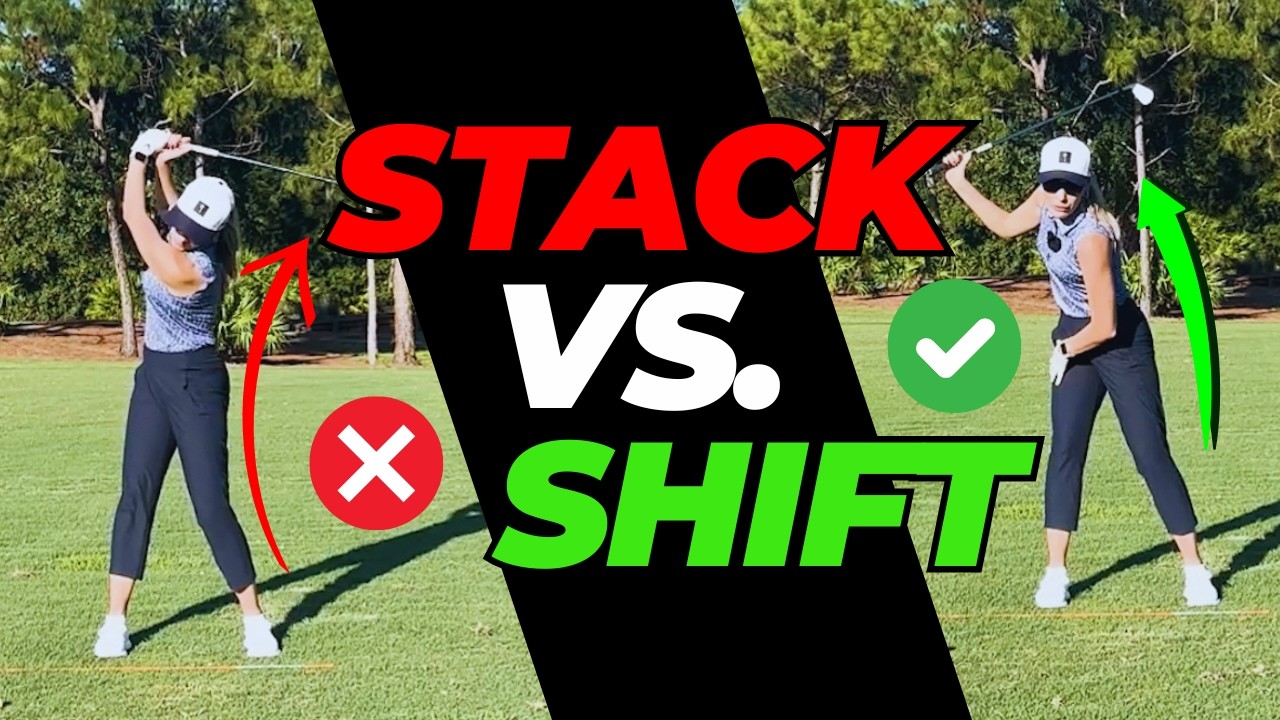
Many golfers focus so hard on turning that their weight stays on the lead foot. At the top they're already forward, so the only way to go is back. Your body jumps out, straightens the lead leg and spins out.
That leads to casting, pushes and pulls. A coil has resistance: the upper body winds against the lower body, with the hips turning about half as much as the shoulders, while you stack over your trail foot.
“turning misses the point in golf that there has to be some resistance”
Coach Carolin, in the lesson at 3:06
The step drill, step by step
- Stand with your feet together.
- Swing back, and halfway back step your trail foot out.
- At the top, step your lead foot out toward the target and swing through.
- Feel your head turn slightly behind the ball as you load.
- Go back to a normal stance and keep the stacked-over-the-trail-foot feel, without sliding your hips away.
How you know it's working
At the top, you feel more pressure on your trail side.
You hold your finish without falling back.
Your lead foot stays planted through impact.
Free: 3 Home Swing Drills
Three 2-minute drills for your hallway. No range, no ball.
Key takeaways
Load firstNo load going back, no shift coming down.
Coil, not turnResistance between upper and lower body.
Stack, don't swayOver the trail foot, hips stay put.
Check the finishFalling back means you stayed forward.
Questions golfers ask
What is a reverse pivot in golf?
Your weight moves toward the target in the backswing and away from it in the downswing, the opposite of what you want.
How much weight should be on my trail side at the top?
More than on your lead side. Stack over your trail foot without sliding your hips away from the target.
Why do I fall back in my finish?
Often because your weight stayed forward in the backswing, so your body moved back to compensate.
Not sure a reverse pivot is your cause?Tell Carolin what your ball does and get your personal fix. Free.
Find my missRead the full video transcript
Auto-captions, lightly edited for names and golf terms.
hi everybody and welcome I'm Coach Carolin former professional Tour player and now social media golf coach for you whenever you don't have time to take an actual lesson I am here for you today I want to talk to you guys about your weight shift and your balance in the golf swing and especially those of you guys who struggle with translating the power into your downswing into your ball a lot of the time it's because you are not sure what you're supposed to be doing with your weight going back and if you don't have the right weight transfer going back you cannot possibly have the correct weight transfer going through the ball and into impact so let's talk about it so a lot of you guys really want to focus on your turn back in the back swing and that's awesome I love a good turn back without a good turn back we can't go anywhere however sometimes what I see with my students is that the focus on the turn back loses the focus on your weight in your back sling so what I see a lot of the time is very common mistake but it's also a pretty detrimental one to the rest of your swing is if people are like oh I'm going to really wind up okay so where's my weight now my weight's on my lead foot right you see this because people are like I am going to turn as much as I can and again not a bad thing to turn as much as you can but you have to turn as much as you can in the correct way without losing your form and this is losing your form you are coming out of your form because you are essentially kind of stack and tilting and you never get your weight onto your right side in the back swing the problem with this is if you have your weight on your lead foot at the top of your back swing where can it go from here not forward you're already forward you're already there the only way of where it's going to go is back and do you see this this is the issue when you don't have the correct weight DFT going back your body is going to counteract it because it's on top or in front of the ball depending on how much you do it and now your body tries to you know compensate and tries to get back behind the ball and I see people kind of jumping out straightening the left leg spaling out and almost spinning out with their hips and that's going to cause casting it's going to cause pushes pulls whatever it could really go anywhere in any direction so we want to make sure we understand what we have to do going back so what we have to do going back is we got to make sure that at least 10 to 15% that's how I feel it goes in into my right foot so I'm not you know swaying I'm not moving my hips this way but I am rotating and kind of stacking over my right foot a lot more than my left foot my left foot is just kind of here for the right my left leg there's not a whole lot of tension here right this is this is kind of you know just hanging out this I'm really coiled and stacked over it and I love to refer to the back turn as a coil not so much as a turn cuz you know turning this this could be turning I'm turning here I'm turning everything I'm also turning this way it's also turning I just turned around right turning misses the point in golf that there has to be some resistance coil however does imply that there's some sort of force at play that you're coiling against so that's why I love to refer to the back swing as a coiling motion versus a turning motion because the upper body will coil against the lower lower body to a certain extent so as I'm coiling back my hips are turned half to my shoulders so 90° 45° we've covered this in a couple of other videos so make sure you go back and watch them I'm going to link them below for you guys but now making sure you feel like your left shoulder turns under your chin and you're stacking over your your Trail foot for me it's my right foot now I'm here I'm loaded about you know 60% 6040 on my trail side maybe 65 to 35 my trail side it depends on the club depends on the shot I'm hitting some shots I want to cover more but on a stock shot let's agree to 60/40 now you're here and now because you're 60% here you have room to actually shift over and be able to initiate your downswing with your hips and with that weight shift and be able to actually come through and really well transfer your weight onto your left foot if you feel like you're falling out of your finish if you feel like you're doing this and your left foot kind of lifts it's likely because your weight actually is on your left foot going back and it never gets to your right foot so here's a really simple drill that you guys can do and I recommend you guys doing this without a ball it's very difficult to do with a ball so I recommend you guys do this as a practice swing you start with your legs almost all the way together it doesn't have to be always like all the way together but you start right around here as you reach halfway back you're going to step out a little bit with your right foot and as you reach the top you're going to step out a little bit with your left foot so this is what it's going to look like let's do that again and that kind of helps you understand first the weight needs to go this way then the weight has to go that way and again it is not a it's not a sway with your hips we want to make sure we turn turn a little bit behind the ball to me personally it feels like if I have a ball here feels like I'm turning a little bit behind the ball actually with my head with my body I'm not staying on top of it if I feel like I would stay on top of it I would have to kind of stay here and it Stacks me more on my left side personally I like to feel like I'm turning a little bit behind the ball with my head even not a TA but a little bit and that allows me to actually shift forward and get my weight towards the target so let's h a ball with this really nice really smooth good contact so essentially if you don't get your weight shift correctly in your back swing you'll never be able to get it correct in your down swing cuz really the golf swing is a game of opposites if you're doing this you're going to do that if you're going back you're going to go forward so let's make sure we understand it let's make sure we do it next time you're on the Range make sure you kind of watch what your feet are doing how you're standing in your finish if you feel like you don't have your full weight on your lead foot in your finish try this little drill go back to this video try to implement this let me know what you think i' always love to hear from you guys and I cannot wait to see you next time if this is your first time here on my channel thank you so much for watching I always appreciate every new subscriber let me know what you want to see next I'm here to help you this is why I do what I do so if you guys leave me a comment below with what you're struggling with and what you want to be working on what you want me to explain to you please let me know hit that like button hit that subscribe button and I cannot wait to work with you guys see you next time

Coach Carolin (Carolin Pinegger)Former tour player, Leadbetter Certified Instructor, GolfPass instructor, Golf Channel's Big Break. Millions of golfers follow Coach Carolin's lessons.