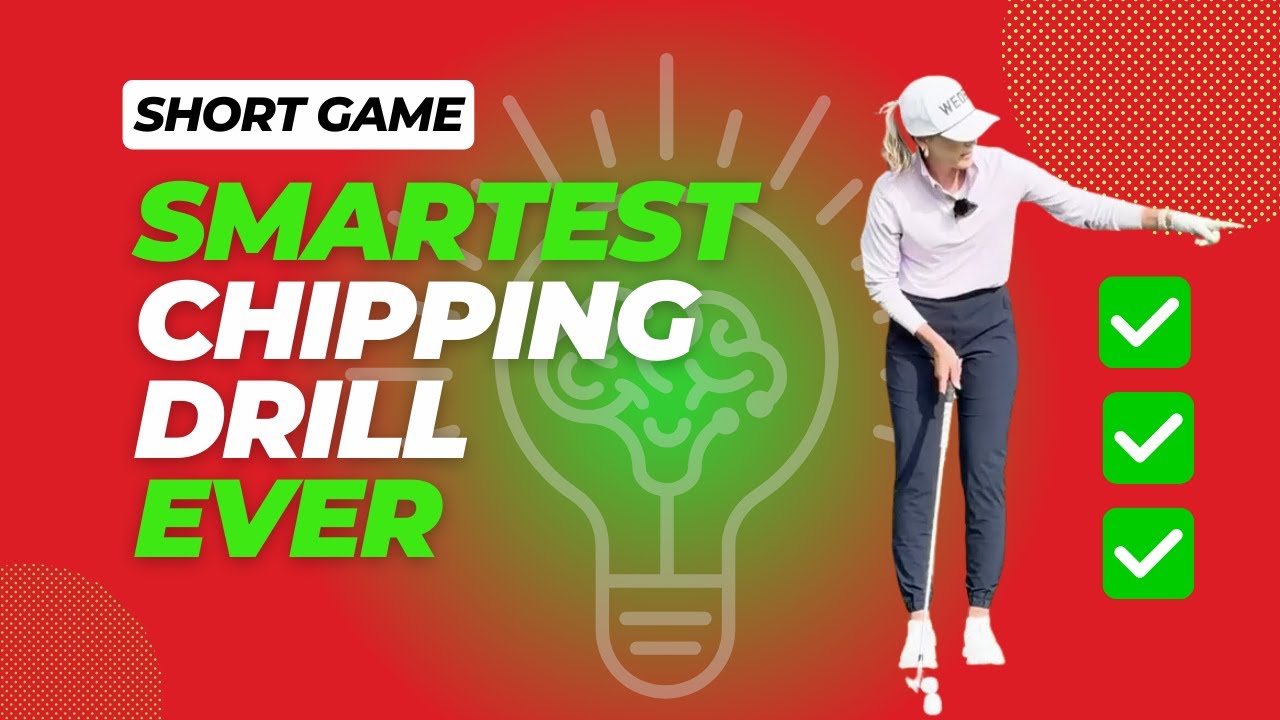
Why chips shank
When the club head goes inside, your hands track out to compensate. Your weight gets dragged back by the club head and then lunges forward toward your toes. Your hands and the face move out, and the hosel meets the ball.
Keeping the club head outside your hands keeps its weight out, so your body pressure can move into your lead heel through impact, away from the hosel.
“I've had the shanks myself.”
Coach Carolin, in the lesson at 0:12
Stop the shanks, step by step
- Set up with your weight even between heels and toes, around your shoelaces, and more on your lead foot.
- Keep your weight there. In chipping, the weight doesn't move back and through.
- Take the club back with the club head outside your hands and your hands close to your trail thigh.
- Through impact, feel the pressure go into your lead heel.
- Drill: drop your trail foot back and chip with the pressure on your lead foot.
How you know it's working
Contact moves to the center of the face.
Your weight stays even instead of lunging to your toes.
No more shanks around the green.
Free: Your personal fix
Tell Carolin what your ball does. Get your fix, the drill video and a range card.
Key takeaways
Two causesClub inside plus weight to the toes.
Even weightAround your shoelaces, more on the lead foot.
Head outside handsIn the takeaway.
Lead heelPressure goes there through impact.
Questions golfers ask
What causes shanked chips?
Usually the club going too far inside combined with your weight moving toward your toes, which brings the hosel to the ball.
Where should my weight be when chipping?
Even between heels and toes, and more on your lead foot. Keep it there through the shot.
Is there a quick fix for the shanks?
Fix the root cause: the club head outside your hands in the takeaway and steady weight, rather than a band-aid.
Read the full video transcript
Auto-captions, lightly edited for names and golf terms.
If you've got the shanks, number one, I'm really sorry. Number two, keep watching because I'm going to cure them. All right, I'm really sorry that you guys got the shanks. I've had the shanks. Just to make you guys feel better, I've had the shanks myself. I had this one year in junior golf where I would literally work my way around the green, like around the green because I just wouldn't get on the green. So, we've all been there, guys, as sad as it is. But we can get out of it together. So, keep watching. I'm going to go through the causes of it and also through the fixes of course more importantly but it is really important to understand why they happen so we can fix it not just like a band-aid and you know kind of on the top but we need to fix the root cause of it. So let's talk about it. All right. So believe it or not you can actually hit two types of shanks. Unfortunately they look the same. Not one is better than the other. They're both bad but I will say that one is more common than the other. So the more common one is the one that happens because you are your club travels too far from the inside number one usually and number two your center of mass goes forward which brings your hands forward which brings that club face forward and since we're addressing it in the center if we bring it forward any you're going to hit a shank because the shank originates from the hoszle right it it basically happens when you hit the ball right here on the inside of your club hit. So, let's talk about why it could happen. So, number one is weight distribution in your heels and toes. So, a lot of people are kind of like, you know, either they're really behind on their they're like this on their heels and then they whip the club in and then when they go through, their weight wants to go forward. But really, in chipping, we want to make sure our weight doesn't really shift. It doesn't actually go back and through either like on a really good like normal golf swing long shot. We want to have the weight forward and we don't want to move that weight over, right? We just kind of want to keep it right here. We're not actually doing this. And we're most certainly aren't doing this. This is this is again not this is shank city, shankaroo, right? So let's make sure that when we're actually chipping, we feel very kind of even out on our feet. We don't feel like we're on our heels. We don't feel like we're super on our toes. So, just feel even. We kind of want to have our weight more in the in the first half of our feet, like kind of where your shoelaces are. That would be ideal. So, just feel that next time you set up. And then we want to make sure that the club head stays outside our hands because when the club head goes in, problem is then our hands, you're kind of going to try to compensate our hands come out. And you see how hands track out, club head tracks too far from the inside. Center of mass goes forward because first the center of mass kind of gets dragged back by the club head and then it goes forward and then we have the shankaroos. Come on in. It's fine. All right. Excuse me guys. Husband came through the door. That does happen when you film your hallway. So we were talking about the shankaroos. I'm sorry. I you know usually this is just like a no-go word, but we got to address it if you have them, right? So, we talked about how we don't want to be back here, right? And we don't want to have that club come forward. So, the biggest fix and the thing that's going to fix them the fastest, guys, is again having good weight distribution back and forth and then feeling like when you take it back, your club head stays outside your hands. Do you feel that? Can I see that? You want to get your hands closer to your trail thigh and you want to get that club head to stay outside and come through because then you're actually going to be able to almost hit it more off the toe. And I mean, not that we want to hit it off the toe, but we definitely want to get closer to the toe if we're shanking it, right? So, it's going to look something like this. A little bit of pressure on the forward foot. 60% feeling like our hands are really kind of close to our thigh. Club head stays out and then we go boom boom. Right? that is going to cure your shanks, guys, pretty immediately, which that's the real fun part. Another nice drill I like to do um to add to this is just kind of popping your right foot back a little bit and really feeling that pressure on your left foot and doing the same thing. Feeling like those hands really kind of track back a little bit more in an arc, but the club head stays out. Do this again. Boom. It's going to cure your shanks, guys. This is it happens and it's okay, but this is why it happens and this is how you cure it. It's pretty quickly um pretty quickly done. So, I know this gets like in people's brains and it's almost like a disease where you're just like, "Oh my god, I've got the shanks." And we've all been infected by it, but this is how you get out of it. All right. Why do you get out of it like this? It's because of the weight distribution in your swing. So, do you see how when we're doing this, do you see how the weight kind of goes forward because your body wants to keep you in balance? So, when the club head weight goes back behind you, your body weight goes forward. But if you actually feel like that club head weight stays out, now where is your weight going to go? Onto your heels, much more likely, right? In the through swing, which that's exactly what we want. We want to feel not in the back swing. We don't want to hang back like we said, right? We want to be nice and even, but then taking the club head outside our hands. And then we can feel like our weight is naturally going to go into our heels much much more going through. That's going to cure your shanks, guys. We just got to get that weight off the toes through impact. So, keeping that club head weight out will make you naturally feel like you're sitting a little bit more pressure in the heel and the front heel and then keep that pressure in the front heel going through. So, you guys have officially been cured. So go get back out on the chipping green and you know just suck it up. It's fine. You shanked a couple and now this is the end of it and you'll never shank again. So thanks so much for watching guys. I really appreciate you. If you want this contraption it's linked down in my description box. It's really handy and um it's really good because you can actually, you know, kind of look at your trajectory. It's a great at home tool. It's a great hallway tool. I mean it even fits into a narrower hallway. So I can highly recommend it. Um all right guys. Well, thanks so much and um leave me a comment below if it cure your shanks. I know it will, but you know, you're welcome. And uh can't wait to see you guys in our next session.

Coach Carolin (Carolin Pinegger)Former tour player, Leadbetter Certified Instructor, GolfPass instructor, Golf Channel's Big Break. Millions of golfers follow Coach Carolin's lessons.